
(for very experienced Algebra I students / Algebra II)
Inventions, as always in history weren’t always appreciated by humans. However, many inventions led to a whole new idea that impacted history forever. For example, Leonhard Euler’s invention of the complex number 
You might be wondering what number’s square is negative. For example, find the value of 

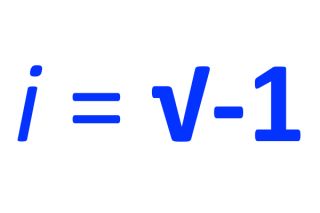
But as mentioned already, there is a notation for denoting these kinds of numbers, and the set of these numbers are called imaginary numbers. The definition of the number 
Let’s do some arithmetic with these types of numbers.
Addition and subtraction would just be the same as a variable. If you add 


Multiplication and division are a little different with this “i”. Let’s see what happens when you raise $i$ to some integer powers. (I might talk about fractional powers later)


We can immediately see that after 

We conclude our observations: the powers of
How does this have to do with multiplication and division? Well a lot, actually.
Let’s start with multiplication. For starters, multiply 


You simply add the powers of
Example: Evaluate 
Solution: We have:

Dividing 18 by 4 gives us 4 with a remainder of 2. We have the second number of the block, which is -1.
Therefore the answer is 
Next, we have a division. We multiply the numerator and the denominator by an imaginary number to get rid of any “i” terms. For example:
Example: Use division to divide 

Solution: We can express this as a fraction: 
We can multiply the numerator and the denominator by

Try some practice problems:
Let 

(a)

(b) 
(c)

(d) Challenge problem: Compute $